
Air Conditioner
Removal & Decommissioning
Artarmon & Sydney's Lower North Shore
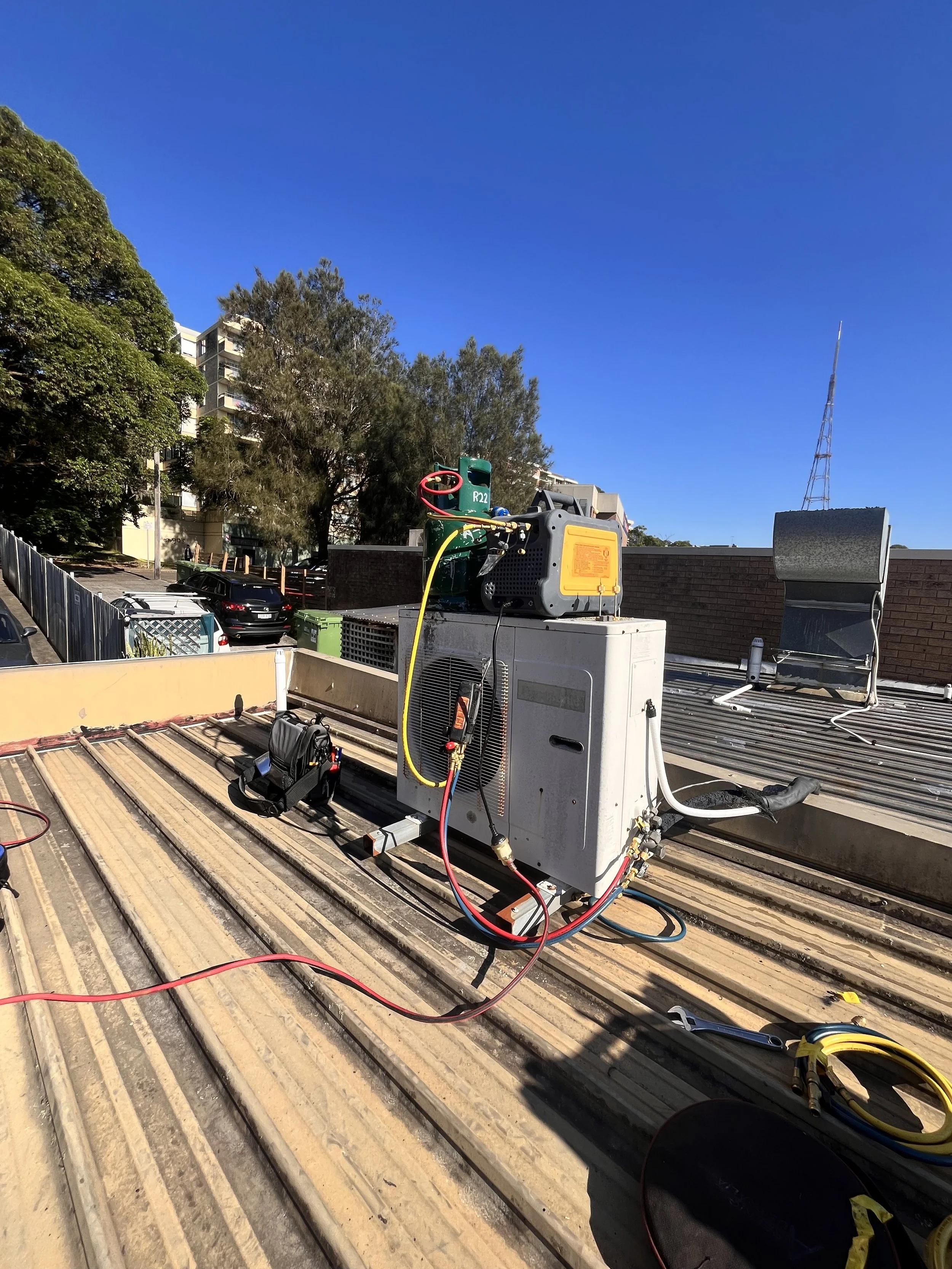
Licensed refrigerant recovery. Old unit off the wall, out of the building and into recycling. A written record of what came out of it.
Taking an air conditioner out is not a rubbish removal job. The refrigerant inside has to be recovered by a licensed technician first, and releasing it into the atmosphere is an offence under Commonwealth law, whatever the quantity. We hold the licences to do it properly, on split systems, multi-heads, ducted systems and small refrigeration.
Who can legally remove an air conditioner
What the Law Says
Under the Ozone Protection and Synthetic Greenhouse Gas Management Act 1989, it is an offence to discharge fluorocarbon refrigerant into the atmosphere, regardless of how much. That covers letting the gas off a system before scrapping it, and it covers cutting the pipes and walking away.
Three things follow from that:
Only a licensed technician can legally get the gas out. Recovering refrigerant requires an ARC Refrigerant Handling Licence. Handling refrigerant without one is a strict liability offence carrying 50 penalty units, which is $18,200 at the penalty unit value that applied from 1 July 2026.
A business needs a separate authorisation to hold and dispose of it. That is a Refrigerant Trading Authorisation. Ours is AU60391.
Discharging it is the expensive one. Conduct that results in the discharge of a scheduled substance carries 300 penalty units, which is $109,200 for an individual and $546,000 for a company.
There is a reason the penalties sit where they do. One kilogram of R410A, the refrigerant in most split systems installed over the last fifteen years, has roughly the same greenhouse effect as two tonnes of carbon dioxide. A typical wall split holds around 0.8 to 2kg, so venting one is comparable to emitting 1,600 to 4,000 kilograms of CO2.
Fun fact, R410A has a higher global warming potential (GWP) than the refrigerant it replaced. However, older refrigerants contain chlorine, which attacks ozone if it is released into the atmosphere and depletes the ozone layer.
What That Means for a Cheap Removal Quote
A rubbish removal or demolition company can only legally recover refrigerant if it holds a Restricted Refrigerant Recoverer Licence and a restricted trading authorisation. Most do not, and most do not mention refrigerant at all.
If nobody on site holds a licence, there are only two places the gas can go. It gets released, which is the offence above. Or the unit goes to a scrap yard still charged, and most scrap metal recyclers will not accept it, because they carry the same obligation.
It is a fair question to ask anyone quoting: which licence are you recovering the refrigerant under, and what will you give me in writing? If the answer is vague, the gas is going into the air.
We hold NSW contractor licence 394793C and Refrigerant Trading Authorisation AU60391, and you get the recovery details in writing on every job.
Frequently Asked Questions
-
Yes. Recovering refrigerant requires an ARC Refrigerant Handling Licence, and a business needs a Refrigerant Trading Authorisation to hold and dispose of it. Under the Ozone Protection and Synthetic Greenhouse Gas Management Act 1989 it is an offence to discharge refrigerant into the atmosphere at all. Artarmon Air Conditioning holds Refrigerant Trading Authorisation AU60391 and NSW contractor licence 394793C.
-
Unbolting a unit is not the problem. The refrigerant is. Releasing it into the atmosphere is an offence carrying 300 penalty units, $109,200 for an individual, and there is no lawful way for an unlicensed person to get it out of the system first. Scrap recyclers will generally refuse a unit that still holds refrigerant, so a licensed recovery is the only clean path.
-
The refrigerant has to be recovered by a licensed technician first, then the equipment goes to a scrap metal recycler. Councils and recyclers handle this differently and many will not accept a unit that still holds gas, so check before you drop one off. Artarmon Air Conditioning recovers, removes and disposes of the equipment in one visit across the Lower North Shore.
-
Only if it holds a Restricted Refrigerant Recoverer Licence and a restricted trading authorisation, which most do not. Ask which licence the refrigerant is being recovered under and what you will get in writing. Without a licence on site the gas is either released illegally or the unit turns up at a recycler that cannot lawfully accept it.
-
It goes into a recovery cylinder, which Artarmon Air Conditioning returns to a refrigerant wholesaler under the Refrigerant Reclaim Australia take-back scheme. Gas returned through that scheme is taken to a facility in Melbourne and destroyed using an Australian-developed plasma arc process.
-
Artarmon Air Conditioning quotes each removal, because the price depends on the equipment, how many units, the access, whether an electrician is needed and how much making good is involved. There is no callout fee inside our service area and no charge for the quote. Send photos of the indoor and outdoor unit and we will usually quote without attending, generally the same business day.
-
Yes. When Artarmon Air Conditioning supplies and installs a replacement, recovering the refrigerant from the old system, removing it and disposing of it is part of the installation quote rather than a separate charge. You should not be paying for removal twice, and if another installer is quoting you separately for it, ask why.
-
Yes. Artarmon Air Conditioning attends pre-demolition and pre-strip-out sites across the Lower North Shore to recover refrigerant from air conditioning and refrigeration equipment, and provides a written record of the type and quantity recovered for the builder's file. A demolition contractor without a restricted recovery licence cannot lawfully do this in house.
Book a Removal
Tell us what you have and where it is, or send a photo, and we will come back with a fixed price.
Artarmon Air Conditioning
ABN 97 428 546 340 | Lic 394793C | RTA AU60391