
VRV & VRF Air Conditioning
Service and repairs across Sydney's Lower North Shore
Every VRF brand, whatever it calls itself. Apartment buildings, offices and larger homes.
VRF air conditioning runs many rooms, sometimes whole floors, from one outdoor unit or a bank of outdoor modules on a single refrigerant network. Every manufacturer gives it a different name, from Daikin VRV to Samsung DVM, with its own controls, fault codes and service software. We service and repair VRF systems from all the major brands, whoever installed them.
What Is VRF Air Conditioning?
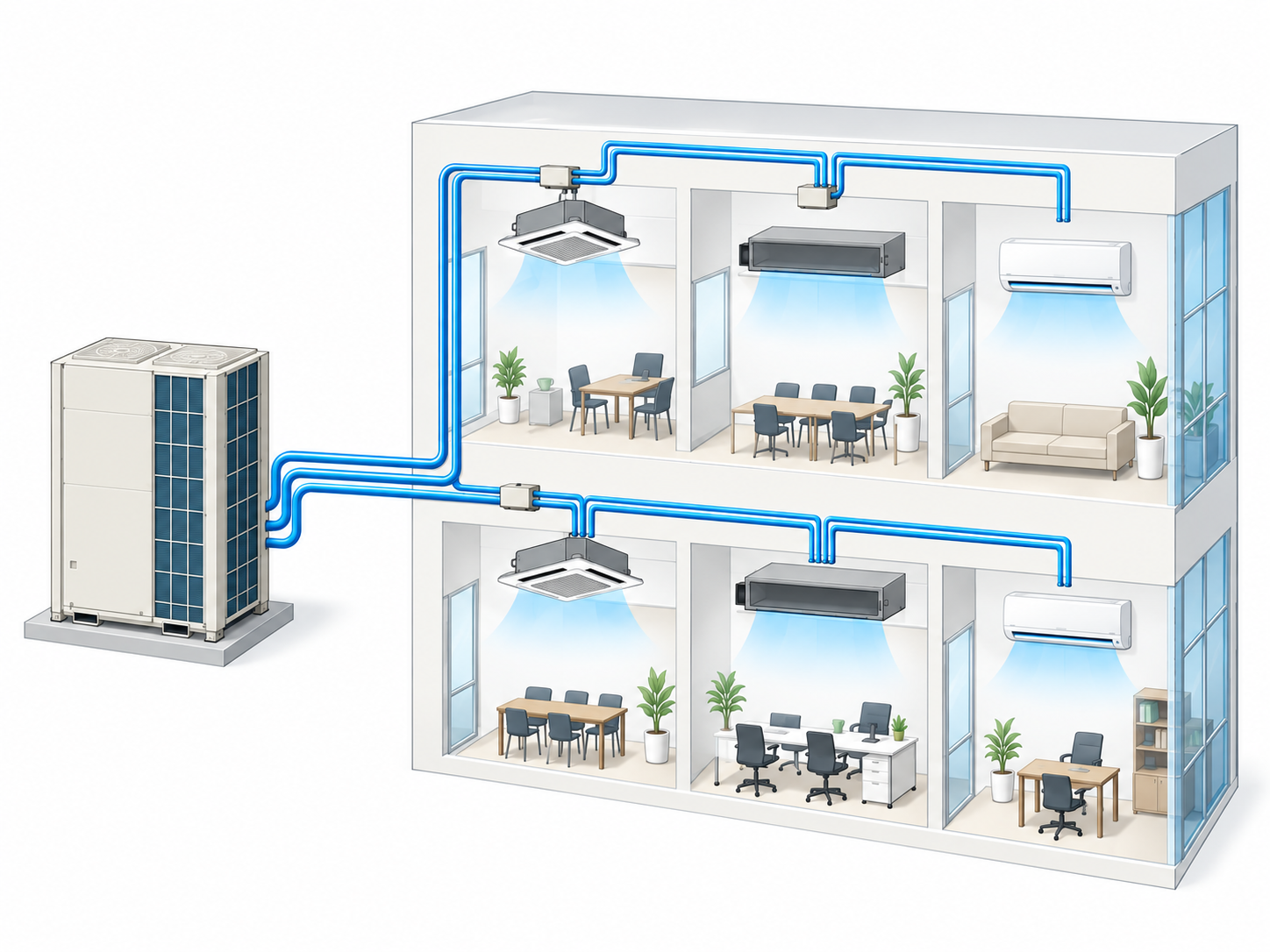
VRF stands for variable refrigerant flow. One outdoor unit, or several outdoor modules working together, feeds a single refrigerant pipe network that branches through the building to many indoor units, often dozens. Each indoor unit has its own address on a communication network and is individually controlled, usually with its own electronic expansion valve, and the outdoor unit varies its output to match what the building is asking for at that moment. The indoor units can be cassettes, ducted units, wall units, floor consoles or a mix, and a larger system is often run from a central controller as well as the controllers in each room.
Heat Pump and Heat Recovery
A heat pump VRF system heats or cools, and the whole system runs in one mode at a time. A heat recovery VRF system can heat some rooms and cool others simultaneously, taking heat out of the rooms that have too much and delivering it to the rooms that need it, through branch selector boxes or a branch controller in the ceiling. Mitsubishi Electric's City Multi R2 series does this on two pipes with a BC controller. Most other manufacturers use three.
VRV Is Daikin's Name for VRF
VRV, short for variable refrigerant volume, is Daikin's trademark for its VRF air conditioning. Daikin introduced the first VRV system in Japan in 1982 and the name stuck, so in Australia plenty of people call any VRF system "VRV" whatever badge is on it. Functionally, a VRV system is a VRF system. Every other manufacturer uses its own name too, and they are listed below.
Mini VRF, and Where Multi-Split Ends
Mini VRF is a compact, often single-phase VRF outdoor unit for a large home, a small office or a restaurant, typically serving up to about ten indoor units. The line between mini VRF and a multi-split is blurry enough that Daikin Australia lists its VRV IV-S alongside its residential multi-split air conditioners. The practical difference is the pipework. A multi-split runs a separate pipe pair from the outdoor unit to each room and tops out at about six rooms, while mini VRF runs one branching network with the same addressed controls as a large VRF system. If your air conditioner has a pipe pair for every room, our multi-split page is the one you want.
VRF Brands We Service,
and What Each One Calls It
Look at the badge on the outdoor unit or the model plate beside it. If the name matches one of these, it is a VRF or mini VRF air conditioner and we work on it.
Daikin: VRV. Current Australian models include VRV H heat pump, VRV R heat recovery, the compact VRV S HSE and VRV IV-S, the water-cooled VRV IV W and VRV WS, and the VRV IV-Q and VRV III-Q units designed to replace older R22 VRV systems on the existing pipework. Older VRV III systems are still in service.
Mitsubishi Electric: City Multi. Heat pump and R2 series heat recovery systems, plus Hybrid City Multi, which runs water rather than refrigerant to the indoor units, and water-cooled models.
Samsung: DVM, short for Digital Variable Multi. DVM S, DVM S2, the compact DVM S Mini and DVM S Eco, and the water-cooled DVM S Water.
LG: Multi V. Multi V 5, the compact Multi V S, and Multi V i, which LG launched in Australia in August 2025.
Toshiba: SMMS, the Super Modular Multi System. SMMS-e, SMMS-u, MiNi-SMMS, and SHRM heat recovery.
Fujitsu: Airstage. J-IVS and the rest of the IV Series, and the J-IIS, J-III, J-IIIL and VR-II systems they replaced. Fujitsu has sold Airstage in Australia since 2002.
Mitsubishi Heavy Industries: KX. The R32 KXZ3 and KX Micro, the KXZP, and earlier KX generations.
Panasonic: ECOi.
Hitachi: Set Free, including Set Free Mini for homes.
Haier: MRV.
Midea: V8 Series, including V8 mini VRF.
Not sure what you have? Send a photo of the model plate on the outdoor unit with your enquiry and we will tell you.
VRV, City Multi, DVM, Multi V, SMMS, Airstage, KX, ECOi, Set Free, MRV and the other product names above are trademarks of their respective owners.
Why VRF Faults Are Different
The components that fail are familiar: filters, coils, drains, fan motors, sensors, valves and boards. What makes VRF different is scale. One outdoor unit may be serving a dozen rooms and several tenants, the refrigerant circuit runs through ceilings and risers, and the controls are a network. A fault can sit in one indoor unit, one branch of pipe, one address on the network or the outdoor modules themselves, and the first job is working out which.
A Communication Network,
Not a Single Cable
Every indoor unit, branch controller and central controller on a VRF system talks over the same communication network, each with its own address. A damaged cable, a loose terminal, water in a junction box or a failed board anywhere on that network can throw communication errors on one indoor unit or across a whole floor, and on a Daikin VRV that includes the familiar U4. The cause is often a long way from the room showing the error.
If the outdoor unit serves more than your own apartment or tenancy, do not switch it off at the isolator yourself. It runs every indoor unit on the system, which may include your neighbours or the business next door, so report the fault to building management and let them call it in.
Not Every Room at Full Power at Once
VRF air conditioning is designed on the basis that not every room needs full capacity at the same moment. Manufacturers let the connected indoor units add up to more than the outdoor unit can deliver, commonly up to 130 or 150 per cent of its capacity and in some ranges more. On a mild day nobody notices. At 4pm on a 38°C day with every room on, the outdoor unit is at its limit and the rooms share what it has. Rated capacity is measured at 35°C outside, and on hotter afternoons every outdoor unit delivers less than it does at 35°C.
That can feel like a fault and often is not one. The inverter is doing what it was designed to do. What we check is whether the system is reaching the output it should for the conditions, because an air con that is short of refrigerant or running with a fouled outdoor coil feels exactly the same from inside the room.
Heating One Room, Standby in Another
A heat pump VRF system runs in one mode at a time, decided by whichever controller or rule it was set up with. When one tenancy wants heating on a cool autumn morning while another is still cooling, one of them waits in standby, and in a mixed-use building that can look like a fault. It is usually a controls question rather than a failed part, and we establish which before anything is replaced. Heat recovery VRF does not have this problem, because it is built to heat and cool at the same time.
Refrigerant Leaks on a Long Pipe Network
A VRF system can have hundreds of metres of refrigerant pipe running through ceilings and risers, with a brazed joint at every branch. When one of those joints leaks, the system does not stop. It gradually loses capacity and starts throwing low refrigerant or high discharge temperature faults, usually on the hottest days first.
Topping it up is not a repair. The correct charge on a VRF system is calculated from the pipe lengths at installation, so the fix is to find the leak, repair it, pressure test and evacuate, and restore the charge by weight to the figure the system was commissioned with. Finding a leak on a pipe network that size is further fault finding, and it is quoted separately once we have seen the building.
Condensate Pumps and Ceiling Units
Many VRF indoor units are cassettes and ducted units hidden in ceilings, and a lot of them rely on a small condensate pump to lift the water out. When a pump fails or its float switch sticks, you either get a drain alarm and the indoor unit shuts down, or you get water through the ceiling. We flow test the drain on every indoor unit at every service (and on pumped units we check the float switch shuts the unit down before water reaches the ceiling).
VRV/VRF Repairs
The first part of a VRF repair is reading what the system has recorded. Controllers display the current error code, and most VRF systems also store a history of recent errors, so we start by working out which indoor units are affected and whether the fault sits with one room, the communication network, the refrigerant circuit or the outdoor modules.
From there it is the same as any repair. We find what has failed, give you a fixed price to rectify it, and nothing starts until you approve it.
Parts for VRF systems are proprietary and specific to the model. Expansion valve coils, sensors, fan motors and boards for a VRF outdoor unit are usually ordered in for your exact model, which takes a few days, and once they arrive you get a priority booking rather than going back to the queue. Where a manufacturer has discontinued a board, we set out the options, including a specialist board repairer, before you spend anything.
If your VRF system is only a year or two old, check whether it is still under the manufacturer's warranty before you call anyone. A fault on a new system is a warranty claim through the installer or the builder, and we will tell you so.
A VRF office floor might be twenty cassettes, and a large apartment on mini VRF might be eight indoor units, each with its own filter, coil, drain tray and drain. Each indoor unit gets the same attention a single split would at the service level you choose, and the system also gets checked as one machine.
Whichever level you book, on a VRF system we:
Clean the filters and test the drain on every indoor unit, not a sample of them
Run every indoor unit and record the temperatures and airflow it achieves, room by room
Read the stored error history, so an intermittent fault that has not yet stopped the system gets found early
Give you a written report covering each indoor unit and the outdoor unit
The deeper service levels add the cleaning, up to a strip-down deep clean of every indoor unit and the outdoor coil. All four levels are set out on our maintenance page.
Apartment Buildings,
Strata and Offices
In apartment buildings, VRF is either a mini VRF system for each apartment, with the outdoor unit on a balcony or a shared plant deck, or a larger system shared by several apartments or a whole floor. Which one you have affects who needs to approve the work. Where the outdoor unit sits on common property, or the system serves more than one lot, we tell you whether strata approval is needed before the work is quoted rather than after.
For strata and building managers, insurance certificates are supplied and any contractor induction completed before the visit. Tell us at booking who manages building access. When several apartments on one system book together, each apartment costs less to service.
In offices, shops and consulting rooms, servicing can be scheduled outside trading hours where the site allows it, and on a VRF system the indoor units can generally be serviced one at a time while the rest of the floor keeps running. Six-monthly servicing is the sensible interval for air conditioning that runs through business hours all year.
How We Price It
Servicing is quoted on enquiry. The price follows the number and type of indoor units, how they are reached (a cassette above an office desk, a ducted unit through a ceiling hatch, a wall unit in a bedroom) and where the outdoor modules are. Tell us the brand, how many indoor units there are and where the outdoor unit sits, and include a photo of the model plate if you can.
Repairs start with a breakdown call. A breakdown call is $299 including GST, which covers attendance and the initial diagnosis of the fault. Once we know what has failed, you get a fixed price to rectify it. Some VRF faults need further fault finding beyond the initial diagnosis, most often a refrigerant leak somewhere on a long pipe network or an intermittent communication fault. Where that is needed, we tell you on site and quote it before we start.
Service Areas
Based in Artarmon, we service and repair VRF air conditioning across the Lower North Shore, including Chatswood, St Leonards, Crows Nest, North Sydney, Milsons Point, Neutral Bay, Cremorne, Mosman, Lane Cove and Artarmon.
Frequently Asked Questions
-
VRF, or variable refrigerant flow, is air conditioning where one outdoor unit or a bank of outdoor modules serves many indoor units, often dozens, through one branching refrigerant pipe network. Each indoor unit is individually addressed and controlled, and the outdoor unit varies its output to match demand. Artarmon Air Conditioning services and repairs VRF systems of every major brand across the Lower North Shore.
-
Yes, in practice. VRV, for variable refrigerant volume, is Daikin's trademarked name for its VRF air conditioning, and VRF, variable refrigerant flow, is the generic term. Daikin introduced the technology in 1982, which is why many Australians call any VRF system VRV. Other manufacturers use their own names: Samsung DVM, Mitsubishi Electric City Multi, LG Multi V and Toshiba SMMS.
-
Look at the pipework and the name on the outdoor unit. A multi-split has a separate pipe pair to each room and serves up to about six. A VRF or mini VRF system runs one branching network and carries a VRF range name such as Daikin VRV, Mitsubishi Electric City Multi, Samsung DVM, LG Multi V, Toshiba SMMS or Fujitsu Airstage. A photo of the model plate settles it.
-
Often because every room is asking for full capacity at once. VRF systems are designed with more indoor capacity connected than the outdoor unit can deliver, commonly up to 130 or 150 per cent, because rooms rarely peak together. On a very hot afternoon they do. Low refrigerant or a fouled outdoor coil feel identical from inside the room, which is what a service checks.
-
Yes. Artarmon Air Conditioning services and repairs VRF air conditioning from every major brand, including Daikin VRV, Mitsubishi Electric City Multi, Samsung DVM, LG Multi V, Toshiba SMMS, Fujitsu Airstage, Mitsubishi Heavy Industries KX, Panasonic ECOi, Hitachi Set Free and Haier MRV, whoever installed them. We work on just about any VRV or VRF system.
-
No. It is illegal in Australia. A VRF system only loses refrigerant through a leak, so topping it up without finding the leak breaches the Refrigerant Handling Code of Practice 2025, AS/NZS 5149 and the Ozone Protection and Synthetic Greenhouse Gas Management Act 1989. Artarmon Air Conditioning finds and repairs the leak, pressure tests and evacuates, then restores the charge by weight to the figure calculated from the installed pipework. Leak finding on a large pipe network is quoted as further fault finding.
-
Artarmon Air Conditioning quotes VRF servicing on enquiry, because the price follows how many indoor units there are, what type they are and how hard they are to reach. A breakdown call is $299 including GST, covering attendance and the initial diagnosis of the fault, and any repair is then quoted at a fixed price before work starts.
-
Yes. We service and repair VRF air conditioning in apartment buildings across the Lower North Shore, working with owners, tenants and strata or building managers. Access, inductions and insurance certificates are arranged before the visit. Where the outdoor unit is on common property or serves more than one lot, we tell you whether strata approval is needed before quoting.