
Package Unit Air Conditioning
Artarmon & Sydney's Lower North Shore
A package unit is the whole air conditioner in one box, and where that box sits changes everything about servicing it. In an apartment it is water-cooled, hidden in a cupboard or above a ceiling, and connected to plant the building owns. On a commercial site it is on the roof, in the weather, and out of sight until the day it stops.
Artarmon Air Conditioning services and repairs both. On apartment units we tell you plainly which side of the boundary a fault sits on, because half of them belong to the building rather than to you. On rooftop units we tell you what the site has to provide before anyone gets up there.
NSW contractor licence 394793C. Refrigerant Trading Authorisation AU60391. Fully insured.
What Is a Package Unit?
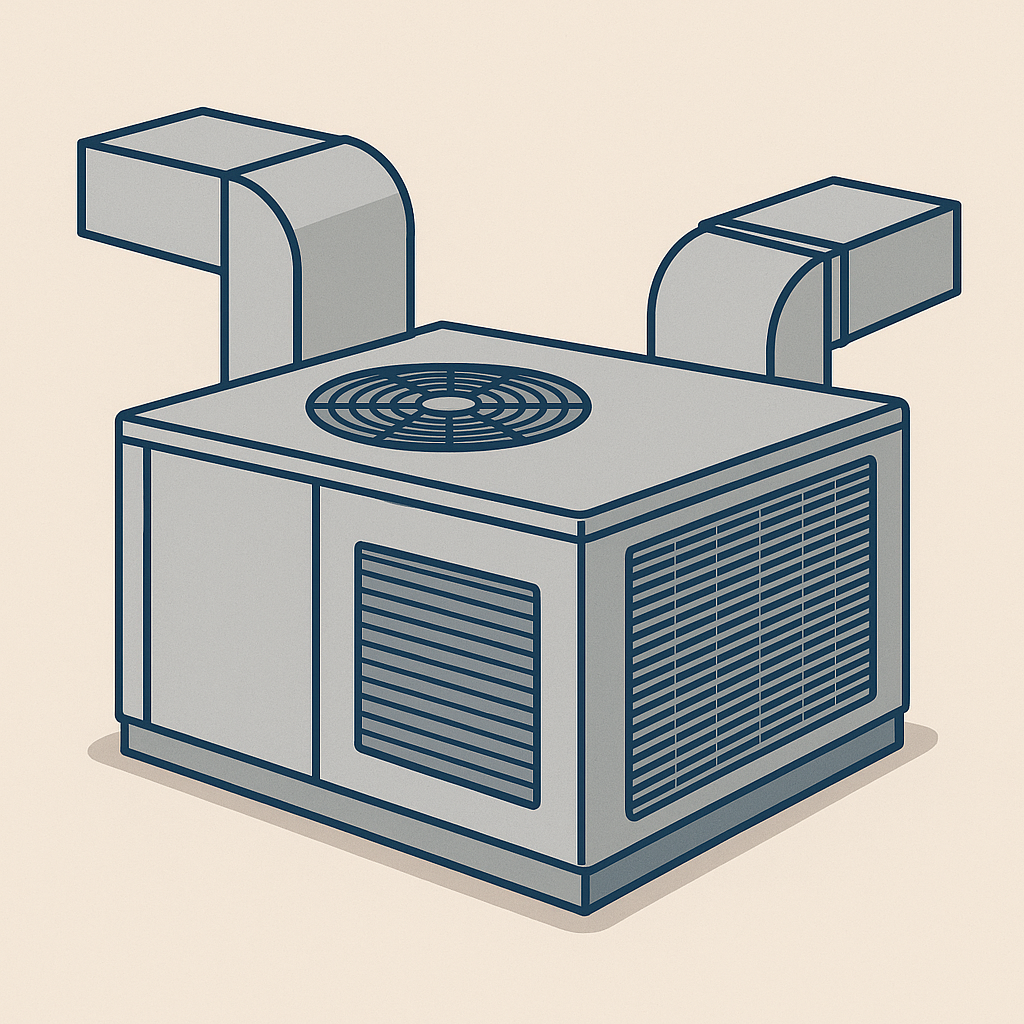
A package unit, also called a packaged air conditioner, has the compressor, condenser, evaporator coil and fan all built into a single cabinet, which then distributes conditioned air through ductwork. That is what separates it from a split system, where the compressor and condenser sit outside and only the indoor fan coil sits inside, joined by refrigeration pipework.
There are two kinds in common use across Sydney, and they are not interchangeable. A water-cooled package unit rejects its heat into a loop of water rather than into outdoor air, which means it can be installed entirely inside a building with no outdoor unit anywhere. These are the ones found in apartments. An air-cooled package unit rejects heat into the air around it, so it has to live outside, which is why it is almost always on a roof. These are the ones found on shops, offices, warehouses and showrooms.
Neither is a bulkhead unit or a split ducted system, both of which keep their compressor somewhere else entirely.
Water-Cooled Package Units
in Apartments
If you live in an apartment with a cupboard air con, you almost certainly have a water-cooled package unit. They turn up in a cupboard off a hallway, living room or laundry, sometimes behind what looks like a linen door, and sometimes concealed above the ceiling of a bathroom, laundry or hallway with only a grille and an access panel showing.
The reason they exist is straightforward. In an apartment building there is often nowhere to put a condenser, no balcony space, no plant deck and no facade the owners corporation will allow one on. A water-cooled package unit removes that problem entirely by dumping its heat into water instead of air. Pipework carries that water up a riser to a cooling tower on the roof, and in some buildings a boiler sits on the same loop, so the loop can carry heat back to units calling for heating in winter.
The trade-off is that your air conditioner is now part of a building-wide system, which is where most of the confusion starts.
What the Building Owns,
and What You Own
As a general rule, the package unit inside your apartment is yours to maintain and repair, and the condenser water loop it connects to is the building's. That loop, the riser pipework, the circulating pumps, the cooling tower and the water treatment that keeps it clean are all common property under the care of the owners corporation, and they are maintained under the building's own arrangements.
It is only a general rule. Where the boundary actually falls depends on the strata plan, the age of the building, whether the unit was installed by the original developer, and any by-law covering air conditioning in your scheme. If it matters, your strata manager is the one who can answer it, not us.
What Artarmon Air Conditioning can do is tell you which side a fault is on. When the unit itself has failed, we diagnose and quote it. When the unit is fine and the problem is on the water side, we say so plainly and tell you what to report to your strata or building manager, rather than charging you to chase a fault that was never yours to fix.
Why Water-Cooled Units
Fail Differently
A split system rejects its heat by blowing outdoor air across a coil. A water-cooled package unit rejects its heat into water. Everything below follows from that one difference, and none of it shows up on a standard split system.
No condenser water flow, or not enough of it. If water is not moving through the unit at the rate it was designed for, the unit cannot get rid of its heat and shuts itself down on a safety, usually on the hottest day of the year when it is working hardest. The causes are almost always outside the unit: an isolation valve someone closed and never reopened, a blocked strainer, a failed water regulating valve, or air trapped in the loop. It looks like a broken air conditioner. It usually is not one.
A condenser scaled up on the inside. The heat exchanger that passes your refrigerant heat into the building's water scales and fouls internally over the years, in much the same way a kettle element does, and how fast depends on how well the building treats its loop water. A fouled condenser produces exactly the symptoms of a refrigerant fault, weak cooling and a unit running constantly, while the refrigerant charge is perfectly fine. Diagnosing one as the other is how people end up paying for gas they did not need.
Condensate going somewhere it should not. The unit sits inside your apartment, so when the drain blocks, the water damages your ceiling, your floor or your joinery, not an outdoor slab. Units concealed above a ceiling are the worst of it, because the first sign is usually a stain.
Noise and vibration you live with. A compressor in a hallway cupboard is inside your home, not outside the building. Perished anti-vibration mounts, a cupboard door with no acoustic treatment, or a unit hard against a wall will carry noise into the apartment and sometimes into the one next door.
Filters nobody has touched. Return air on these units usually comes through a grille in the cupboard door or in the ceiling, and the filter behind it gets forgotten for years. A loaded filter chokes airflow, ices the coil and eventually leaves dust on the coil itself, which is a far more expensive problem than a filter.
Access that was designed once and never revisited. Cupboards get joinery built into them, access panels get painted shut, and shelving gets installed in front of the unit. It is the same story as a bulkhead air conditioner, and it has the same effect on what a service costs.
Rooftop Package Units
An air-cooled package unit on a roof, also called a packaged rooftop unit, is the standard air conditioner for shops, offices, warehouses, showrooms, medical suites and small commercial fitouts across the Lower North Shore. The entire system sits in one weatherproof cabinet up there, ducted down through the roof or the ceiling into the space below, which keeps all the plant out of the tenancy and all the noise off the floor.
It also keeps the plant out of sight, which is why most of them are only looked at after they have stopped.
Why Rooftop Units Wear Out Faster
A rooftop package unit does more running hours than a household system and does all of them exposed. These are the faults Artarmon Air Conditioning attends most on them.
Everything is outside, all year. Sun, rain and, close to the harbour and the coast, salt air. Cabinet panels and base rails corrode, weather seals perish, and the flashing around the duct penetrations is a genuine roof leak waiting to happen. A unit with rust in the base rails is telling you about the last ten years of maintenance.
Belt-driven fans, on the units old enough to have them. Supply fan belts glaze, stretch and shed, and bearings dry out. It is a wear item a split system does not have at all, and a snapped belt is one of the most common reasons a rooftop unit runs, sounds normal from below, and delivers no air.
A condenser coil full of the roof. Leaf litter, dust off a car park or a yard, grease carried across from a nearby kitchen exhaust, and drift from a cooling tower all end up in the coil. A coil that cannot reject heat trips the unit on its safeties in the afternoon and clears itself by morning, which is why these faults get reported as intermittent.
A return air filter nobody has changed. Out of sight, out of mind, and the single most common cause of a "not cooling" call on a commercial site. A loaded filter collapses airflow, ices the coil, and shuts the unit down.
Contactors and capacitors. Commercial equipment starts and stops far more often than a domestic system, and these are the parts that wear out from it. They are cheap, they are stocked, and they are the reason a fast diagnosis is worth more than a fast parts swap.
Drainage that has nowhere to go. Condensate drains on a roof block with debris, and the water backs up into the drain tray and then into the ductwork, or pools on the roof around the unit.
Controls that have drifted. Time clocks, outside air dampers and their linkages, and building management connections where they exist. A unit conditioning an empty building all weekend is not broken, but it is costing the tenant money every month.
What We Need to Get on the Roof
This is worth saying plainly, because it decides whether a job can happen on the day it is booked.
Artarmon Air Conditioning needs safe, compliant access to the unit. In practice that means a fixed ladder, a roof hatch or a permanent stair rather than an extension ladder off a loading dock, and edge protection, a guardrail or fixed anchor points where the unit sits near an unprotected edge. Where your site requires an induction, a permit to work or a key from a building manager, tell us at booking who manages access, so the visit is not held up on the day.
Where compliant access does not exist, we will say so and tell you what would need to change, rather than improvising something unsafe on your roof. That occasionally costs us a job. It is not negotiable.
Maintenance Intervals
for Commercial Duty
A rooftop package unit running through business hours all year does several times the operating hours of a household system, so Artarmon Air Conditioning recommends quarterly maintenance on commercial rooftop package units, rather than the once or twice a year that suits a home. Filters, belts where fitted, the condenser coil and the drain are the four things that cause most breakdowns, and all four are maintenance items rather than repairs.
Servicing can generally be scheduled outside trading hours where the site allows it, so a shop or a showroom is not working around us. See our maintenance page for what each service level covers.
Return air filter condition, and whether it can actually be reached and changed
Evaporator coil and drain tray condition, and the condensate drain flow tested
Condenser condition: the water-cooled heat exchanger and its water flow, or the air-cooled coil and its clearances
Refrigeration performance measured and recorded, rather than assumed from how it feels
Electrical checks on contactors, capacitors and connections, which do most of the failing on commercial duty
Fan, belts and bearings where fitted, and anti-vibration mounts on units installed inside a home
Cabinet, base rails and weatherproofing on rooftop units, including the duct penetrations
Findings explained in plain English, with a fixed price for any repair before it starts
Artarmon Air Conditioning diagnoses the fault, explains what failed and why, and quotes the repair at a fixed price before anything is done. On package units the diagnosis is worth more than usual, because so many of the faults imitate each other: a fouled water-cooled condenser looks like low refrigerant, a blocked filter looks like a failed compressor, and a closed valve in a riser cupboard looks like a broken air conditioner.
Parts are the other thing worth knowing about in advance. Most package unit parts are model-specific and have to be ordered, which often means a second visit, and on discontinued units availability is a real constraint that feeds into the repair or replace decision. See our repairs page for how a breakdown call works.
Service Areas
Based in Artarmon, we work on package unit air conditioning across:
Artarmon, Chatswood, Castle Cove, Lane Cove, Lane Cove West, Willoughby, Northbridge, Naremburn, Crows Nest, St Leonards, North Sydney, Mosman, Cremorne, Roseville, Lindfield, Killara, Gordon, Pymble, St Ives, Turramurra and Wahroonga.
See every suburb we cover on our Lower North Shore and Upper North Shore pages.
Book a Package Unit Service
Tell us where the unit is, in a cupboard, above a ceiling or on a roof, and what it is doing. A photo of the unit and its data plate tells us more than anything else you can send, and it means we arrive knowing what we are working on.
Frequently Asked Questions
-
A package unit has the compressor, condenser, evaporator and fan all in one cabinet, distributing air through ductwork, unlike a split system where the compressor sits outside in a separate unit. Artarmon Air Conditioning services two kinds across Sydney's Lower North Shore: water-cooled package units installed inside apartments, and air-cooled package units installed on commercial rooftops.
-
Because there was nowhere to put an outdoor condenser. A water-cooled package unit rejects its heat into a loop of water that runs up to a cooling tower on the roof, so the whole air conditioner can sit inside your apartment, usually in a cupboard or concealed above a ceiling. It is the standard solution in apartment buildings with no plant deck and no facade space for condensers.
-
As a general rule the package unit inside your apartment is yours, and the condenser water loop, pumps and cooling tower are common property maintained by the owners corporation. The exact boundary depends on your strata plan, the building's age and any by-law, so your strata manager is the one to confirm it. Artarmon Air Conditioning will tell you which side of that line a fault sits on.
-
The most common cause is not enough condenser water flowing through the unit, so it cannot reject its heat and shuts down on a safety just when it is working hardest. A closed isolation valve, a blocked strainer, a failed water regulating valve or air in the loop will all do it. Artarmon Air Conditioning checks the water side before condemning anything inside the unit.
-
Very often a scaled or fouled condenser. The heat exchanger that passes heat into the building's water fouls internally over the years, much as a kettle element does, and how fast depends on how well the loop water is treated. It produces exactly the symptoms of low refrigerant, which is why Artarmon Air Conditioning measures performance rather than assuming a system needs gas.
-
Sometimes, but less often than people expect, because a split system needs somewhere outside for a condenser and those buildings usually have nowhere. You would also need owners corporation approval, and in many schemes the condenser water charge stays in your levies regardless. Changing the unit over for another package unit is usually simpler, and only needs the building to isolate the water side.
-
Artarmon Air Conditioning recommends quarterly servicing on commercial rooftop package units, because equipment running through business hours all year does several times the operating hours of a household system. Filters, belts, the condenser coil and the condensate drain cause most rooftop breakdowns, and all four are maintenance items rather than repairs.
-
Safe, compliant access to the unit: a fixed ladder, roof hatch or permanent stair rather than an extension ladder, and edge protection or fixed anchor points where the unit sits near an unprotected edge. Tell Artarmon Air Conditioning at booking if your site needs an induction, a permit or a key from a building manager. Where compliant access does not exist, we will say so rather than improvise.