
Air Conditioner
Deep Cleaning
Artarmon & Sydney's Lower North Shore
If your air conditioner smells musty when it starts, or you can see black spotting on the fan through the louvres, cleaning the filters will not fix it. The growth is behind the filters, on parts a routine service does not reach. A deep clean strips those parts back, treats them chemically and flushes them, and on an air con that has earned it the water coming out is black.
NSW contractor licence 394793C. Refrigerant Trading Authorisation AU60391. Fully insured.
Do you need a deep clean, or a service?
Most air conditioners need a service, not a deep clean. A service once a year keeps an air con in the condition where a deep clean never becomes necessary, and it is the cheaper job. So it is worth being straight about when the deeper job is actually warranted.
Book a deep clean if any of these are true:
There is a musty or sour smell for the first minute or two after it starts
You can see black or grey spotting on the fan barrel through the louvres
It has not been serviced in three years or more
You have just moved in and have no idea when it was last touched
Airflow has dropped noticeably and the filters are clean
Someone in the house is sensitive to airborne mould
A service is the right job if:
It was serviced within the last year or two and nothing smells
The only symptom is dusty filters
It is a newer air con that has not missed a service
If you are not sure, send a photo. Take one straight into the louvres with a torch on, and one of the outdoor unit. That is usually enough for us to tell you which job you need, and we will say service if service is the answer.
Where the Mould Actually Grows
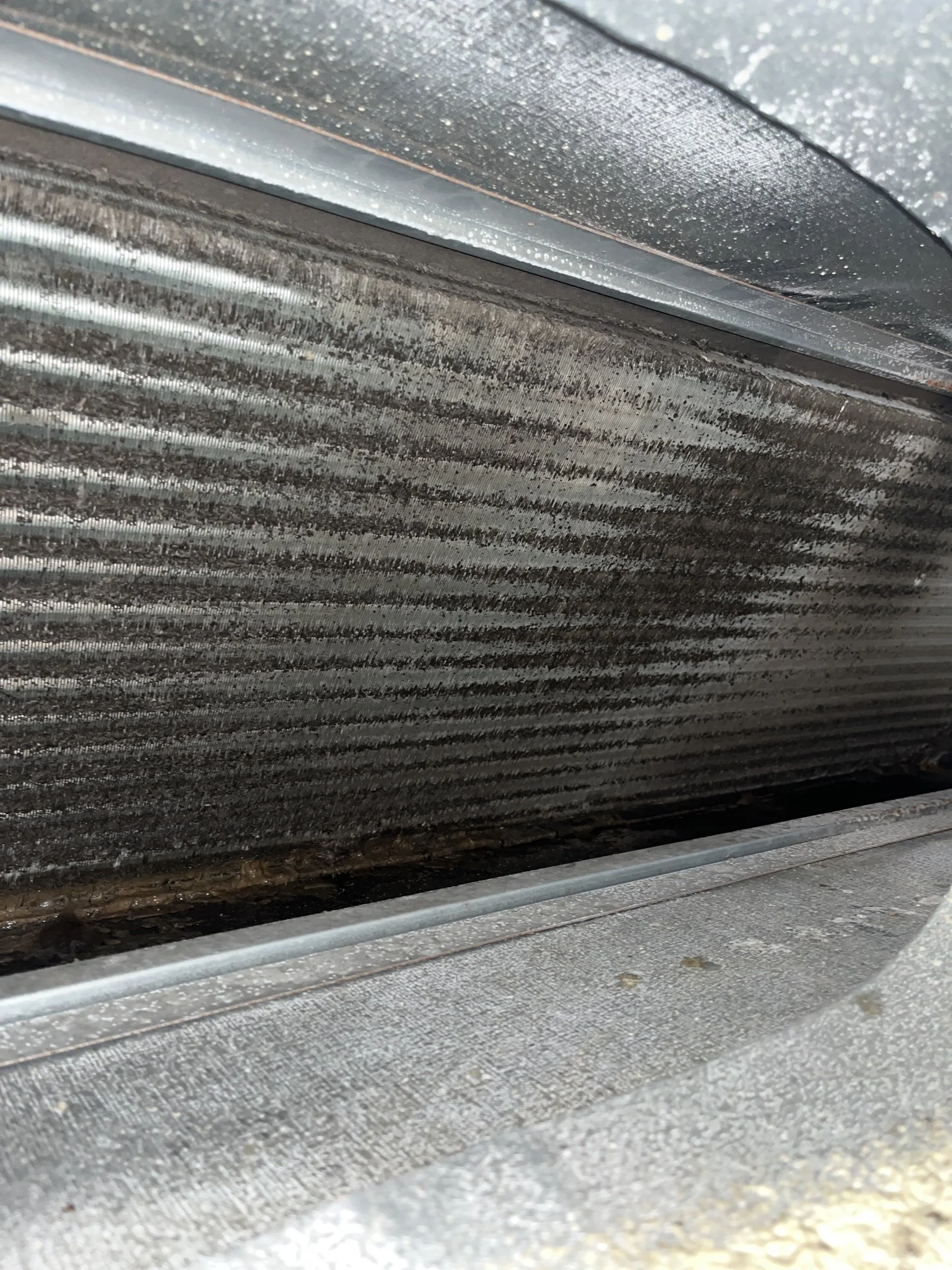
An air conditioner in cooling makes its own water. Warm room air passes over a coil sitting below the dew point, moisture condenses on the fins, runs down into a tray and out through the drain. That is the machine working correctly.
The problem is what else lands there. Filters catch the coarse dust, but the fine airborne dust, skin cells, cooking oils and pet dander pass straight through and stick to a wet aluminium coil. Wet surface, organic matter, no light, steady temperature. That is a growing medium, and what grows on it is a biofilm of mould and bacteria.
Three places it collects, none of which a filter clean reaches:
The indoor coil. Behind the filters, where the condensation forms. The fins are packed a millimetre or two apart, so once growth is established, wiping the face of the coil does nothing to what is sitting three centimetres in.
The fan barrel. The long slotted cylinder that pushes air into the room. It runs wet, it has dozens of small blades, and it is the single dirtiest component in a neglected air con. It is also the one you can see, if you shine a torch through the louvres.
The drain tray and line. Biofilm sloughs off the coil, lands in the tray and washes into the drain, where it builds into a plug. This is how a cleaning problem becomes a water-through-the-ceiling problem.
Every time the fan runs, room air passes over all three.
One thing you can do for free, tonight. Running the fan alone for ten to fifteen minutes after you finish cooling helps dry the coil before the machine sits idle overnight. Some brands do this automatically and call it something like self-clean or dry keep. It will not clean an air con that is already fouled, but on a clean one it meaningfully slows how fast the growth comes back.
What an Aircon Deep Clean Involves
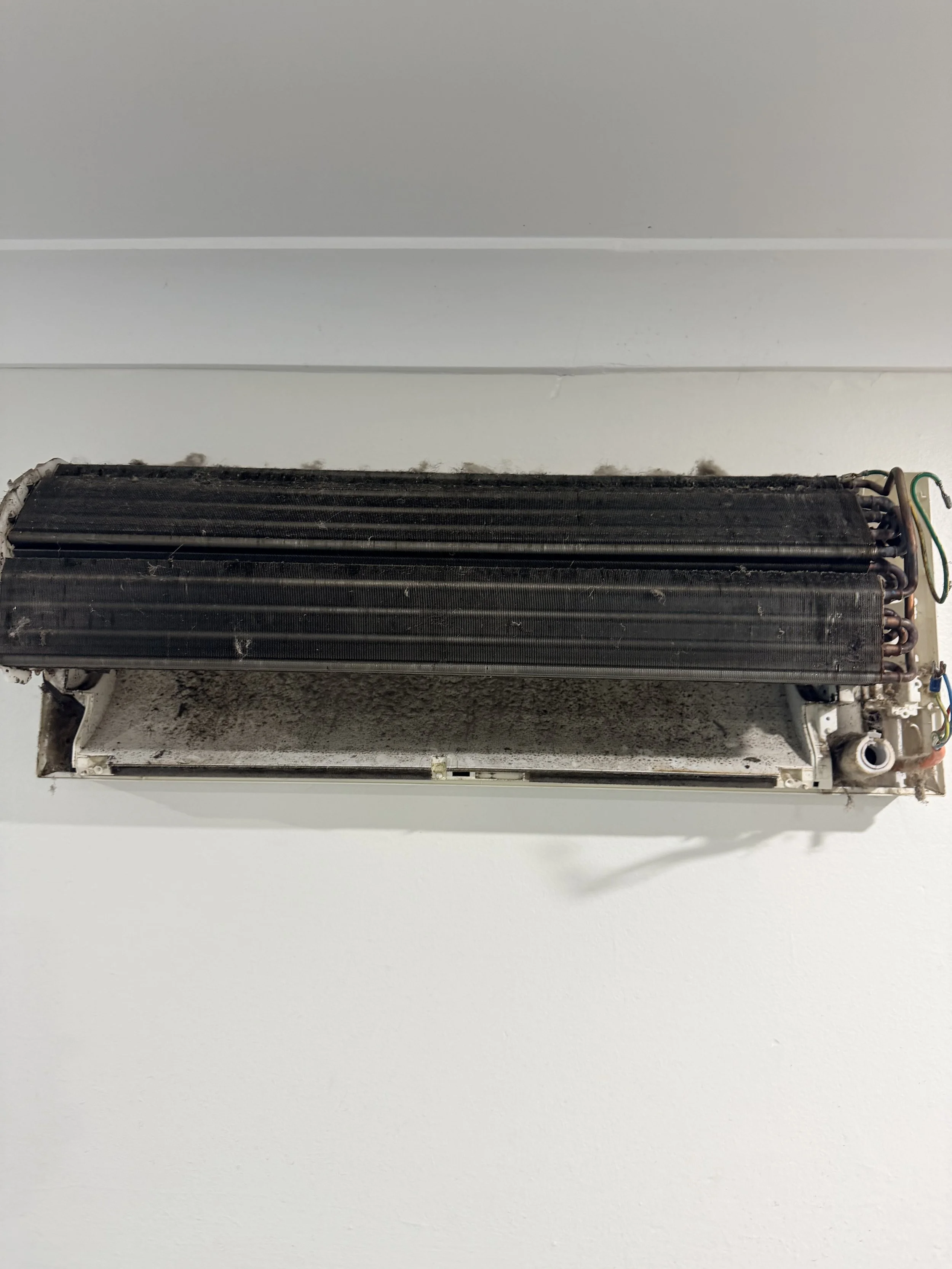
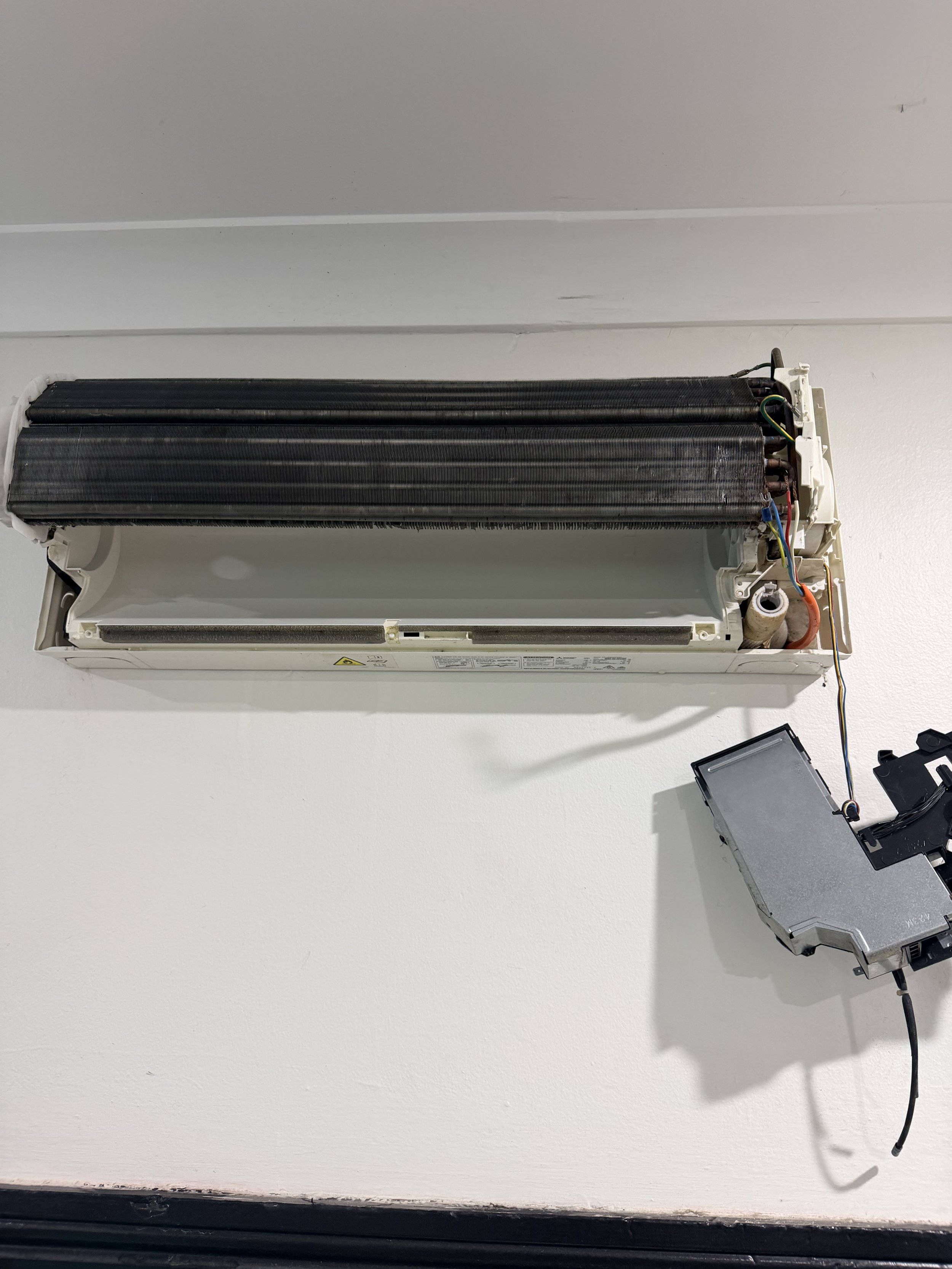
The electrics come out before any water goes in. The control board, the wiring, the fan motor and the sensors are removed from the air conditioner first, so there is nothing sensitive left to get wet. This is the step that separates a clean from a callback. Water sitting in a connector or a motor winding does not announce itself on the day. It announces itself the next time the air con is switched on.
On an older air conditioner some of that hardware is seized in place and will break coming out. Where that happens we leave it where it is and mask it, taping over everything sensitive so it stays dry, rather than forcing a part that was never designed to come out twice.
Then it comes apart. The front cover, the louvres, the filters, the drain tray, the fan barrel and as much of the case as will release all come off the wall. On most air conditioners what is left up there is the back of the case and the coil, with a waterproof catch bag fitted around it so the wash water runs into a bucket instead of down your wall.
Every component is then cleaned individually, in the hand, where it can actually be reached. A fan barrel scrubbed through a gap in the louvres is not the same job as a fan barrel cleaned off the wall, and the difference is visible when it goes back in.
Heavy duty coil cleaner is applied to the coil and left to soak, so it lifts the growth out from between the fins rather than off the face of them
The coil is rinsed, then soaked a second time and rinsed again, because one pass does not clear a fin pack that has been building for years
Rinsing is done with hot water wherever the property has it, which shifts the oils and the cleaner residue that cold water leaves behind
Pressure is kept high enough to clear the fin pack and low enough not to fold the fins over, which is the damage most commonly done by people cleaning coils in a hurry
The fan barrel, the drain tray, the louvres, the filters and the case parts are each cleaned separately
Once the coil is clean it is disinfected and deodorised
The drain line is cleared and flow tested with water
Everything is dried, reassembled, and the electrics and motors refitted
The air con is run up afterwards, with supply and return temperatures and airflow recorded, so there is a number showing what the clean recovered
What stays on the wall is the coil and part of the case. Nothing is disconnected from the refrigerant circuit to clean it, so there is no gas to recover and no reason for a clean to become a repair.
The Outdoor Unit
The outdoor coil is where your air conditioner dumps the heat it has taken out of the room. When it is packed with dust, salt or leaf litter it cannot reject that heat, so the air con runs hotter and longer for the same result, and on the hottest days it may never reach temperature at all.
The casing is opened up and the coil cleaned through from the inside out, which is the direction the dirt went in
The condenser fan and the fan housing are cleaned
Surface rust on the casing is knocked back and treated before it works into the metal
Leaf litter and debris are cleared from around the base
Outdoor cleaning is what actually recovers running cost and capacity. Indoor cleaning is what fixes the smell. Most air conditioners that need one need the other, which is why they are usually booked together.
Why Ductwork Gets Replaced
Rather Than Cleaned
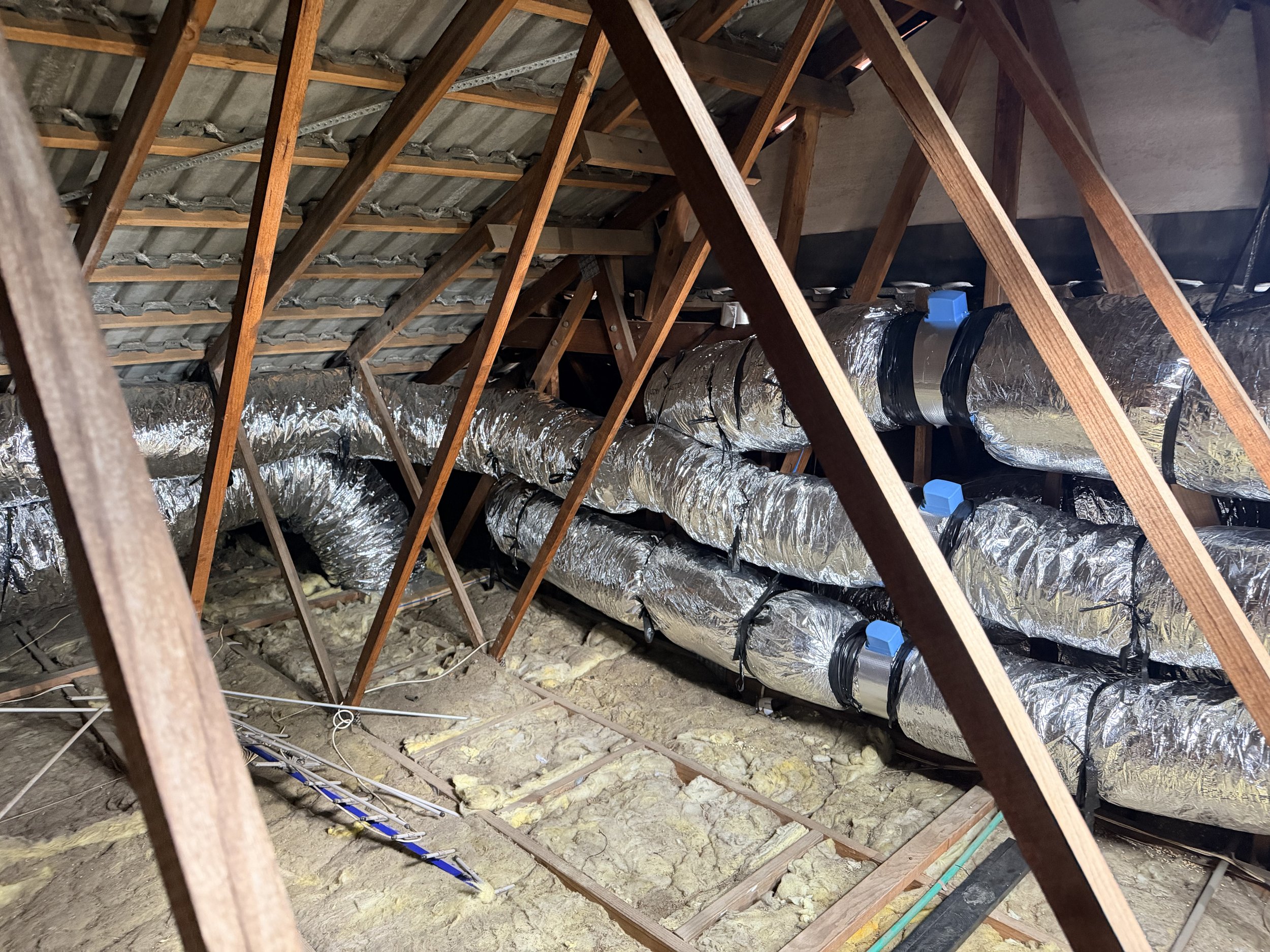
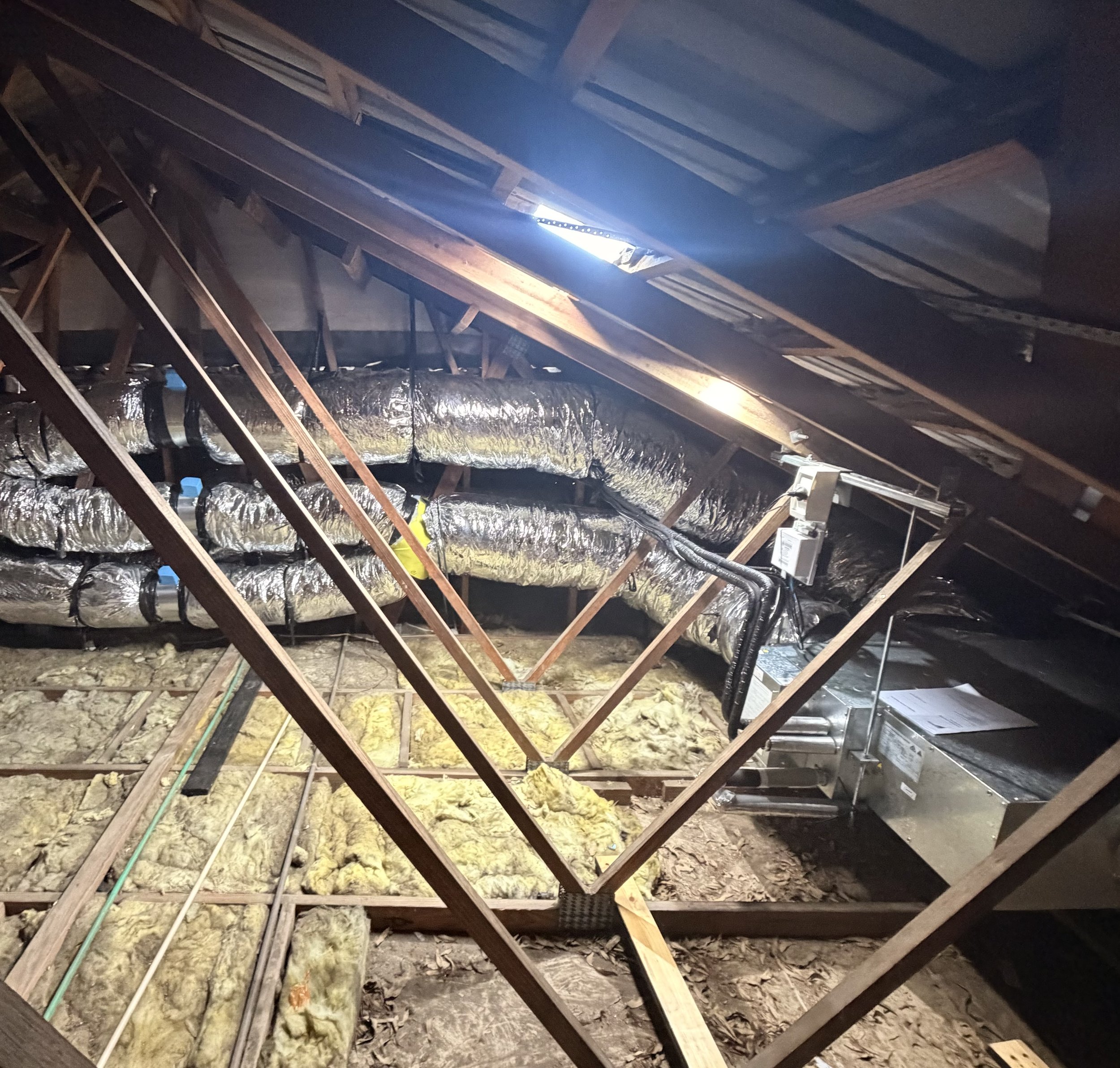
Australian homes are ducted almost entirely in insulated flexible duct, which is comparatively cheap to buy and straightforward to replace. By the time a duct run is dirty enough to be worth cleaning, it is usually old enough that cleaning it is money spent on something already near the end of its life.
Replacing it is normally the better spend, and it fixes what cleaning never could. Most of our duct replacements include a redesign: run sizes corrected, unnecessary bends taken out, crushed and kinked sections replaced, takeoffs and return air sized properly. That is what fixes the back bedroom that has never cooled, and no amount of cleaning was ever going to touch it.
A duct replacement usually takes more than a day, so it is quoted and booked as its own job. The fan coil can be stripped and deep cleaned as part of it, so the system comes back clean, with ductwork that performs the way it should have from the start.
Most ducted systems do not need any of this. If yours is not especially old and the airflow is reasonable, the fan coil clean is the whole job and we will tell you so.
Mould, Air Quality,
and What We Will Not Tell You
Mould and bacterial growth on an air conditioner's coil and fan barrel is real, it is common, and air passes over it every time the fan runs. Airborne mould is a recognised indoor air quality issue and some people are noticeably sensitive to it.
What we will not do is tell you what is in your air or what it is doing to your health. We are a licensed air conditioning business, not an indoor air quality laboratory and not medical practitioners, and any air conditioning company that offers you a health verdict on the phone is guessing.
What we can do is show you. You get a photograph of the fan barrel before and after, so you can see for yourself what was in the airflow. If you want the air itself tested, that is a job for an occupational hygienist, and we are happy to be told what to fix once you have their report.
One boundary worth stating plainly. If there is mould on your walls, your ceilings, your window reveals or in a wardrobe, your air conditioner is almost certainly not the cause and cleaning it will not fix it. That is a building moisture problem, usually ventilation, insulation or a leak, and it needs a building remediation specialist. Cleaning an air con in a room with a moisture problem buys you a few months at most, and we would rather say that than take the job twice.
What a Deep Clean Will Not Fix
A clean is a clean. It is not a repair, and it is worth knowing where the line sits before you book.
A drain that has lost its fall, or a cracked drain tray. We clear and flow test the drain as part of the clean. If the drain backs up because the line runs uphill or the tray is split, that is a repair. You will be told on the day and quoted separately, and nothing proceeds until you approve it.
Low refrigerant or a failing component. If the air con is not cooling properly, cleaning it may help and may not. A performance fault is a diagnosis job, not a cleaning job.
An installation fault. Indoor units mounted without fall on the drain, condensate lines run into the wrong place, outdoor units boxed into a space with no airflow. Cleaning does not correct any of it.
A smell that is not the air conditioner. A dry floor waste trap, something dead in the roof space, a damp subfloor or a fridge condensate tray will all produce a smell that arrives about when the air con starts, because that is when the air starts moving. If a clean does not fix the smell, it was probably not coming from the air con, and we will help you work out what it was.
If we find a fault during a clean, you get it explained in plain English and a fixed price to rectify it before any repair work starts. See our air conditioning repairs page for how that works.
How We Price a Deep Clean
Deep cleans are quoted on enquiry, because two houses with the same number of air conditioners rarely take the same time. Four things set the number: the type of air conditioner, how many are at the address, the condition they are in, and how hard they are to reach. Additional units at the same address cost less than the first, because we are already there and set up.
More information is set out on our air conditioning maintenance page.
To get a number: send us the type of air conditioner, how many you have, roughly when it was last serviced, and a photo into the louvres with a torch on. Most enquiries are answered the same business day, and most can be quoted without a visit.
Where Deep Cleaning Sits in
Our Maintenance Levels
A deep clean is not a separate product for us, it is the top of our maintenance range. Premium is the full indoor deep clean described above. Premium Pro Max Ultra adds the same treatment to the outdoor unit.
You can book either as a one-off. Most people do, because a deep clean is usually prompted by a smell rather than by a calendar.
What happens after is worth thinking about now. Once an air con has been reset, it does not need the deep job again for years. It goes back onto regular servicing, twice a year or once a year at minimum, which is a smaller visit, and that is what stops it getting back to where it is today. If you would rather not have to remember, we will contact you when it is due.
The four levels are compared side by side on our air conditioning maintenance page.
Systems We Clean
Wall-mounted splits, multi-head systems, ducted fan coil units, cassettes, bulkhead units, floor consoles, package units & VRV/VRF, for any brand, whoever installed them. Bulkhead units are quoted separately, because reaching the coil means opening the ceiling or removing the unit.
Having an independent licensed technician clean your air conditioning does not affect the manufacturer's parts warranty, provided the technician is working under a Refrigerant Trading Authorisation. Ours is AU60391 and our NSW contractor licence is 394793C.
Commercial and Strata Cleaning
Artarmon Air Conditioning deep cleans air conditioning in offices, shops, studios, salons, gyms and consulting rooms across the Lower North Shore, including cassette and bulkhead units. Sites where people are in the airflow all day, or where the air conditioning runs year-round, reach the point of needing a deep clean considerably faster than a house does.
Cleaning can be scheduled outside trading hours where the site allows it.
Service Areas
Based in Artarmon, we deep clean air conditioning across:
Artarmon, Chatswood, Castle Cove, Lane Cove, Willoughby, Northbridge, Naremburn, Crows Nest, St Leonards, North Sydney, Mosman, Cremorne, Roseville, Lindfield, Killara, Gordon, Pymble, St Ives, Turramurra and Wahroonga.
See every suburb we cover on our Lower North Shore and Upper North Shore pages.
Book a Deep Clean
Send a photo into the louvres and we will tell you whether you need a deep clean or just a service.