
Air Conditioning Repairs
Artarmon & Sydney’s Lower North Shore
Fixed price initial diagnosis. Faults explained in plain English. Licensed technician on every job.
If your air conditioner is leaking water, tripping the switchboard, throwing an error code or blowing warm air, the job is to work out why before anything gets replaced.
Artarmon Air Conditioning charges $299 including GST for a breakdown call in our service area. That covers attendance and the initial diagnosis of the fault. Once we know what has failed you get a fixed price to rectify it, and the decision stays yours. We repair split systems, multi-head, ducted, cassette, bulkhead, floor console, package units and VRV/VRF air conditioning systems, whoever installed them.
NSW contractor licence 394793C. Refrigerant Trading Authorisation AU60391. Fully insured. Workmanship guaranteed for five years.
Book a repair assessment and get your system working again sooner.
What a Breakdown Call Includes
Every air con repair call from Artarmon Air Conditioning starts the same way.
A fault that is diagnosed properly only gets fixed once.
Full system test in the modes that are failing, with supply and return air temperatures measured
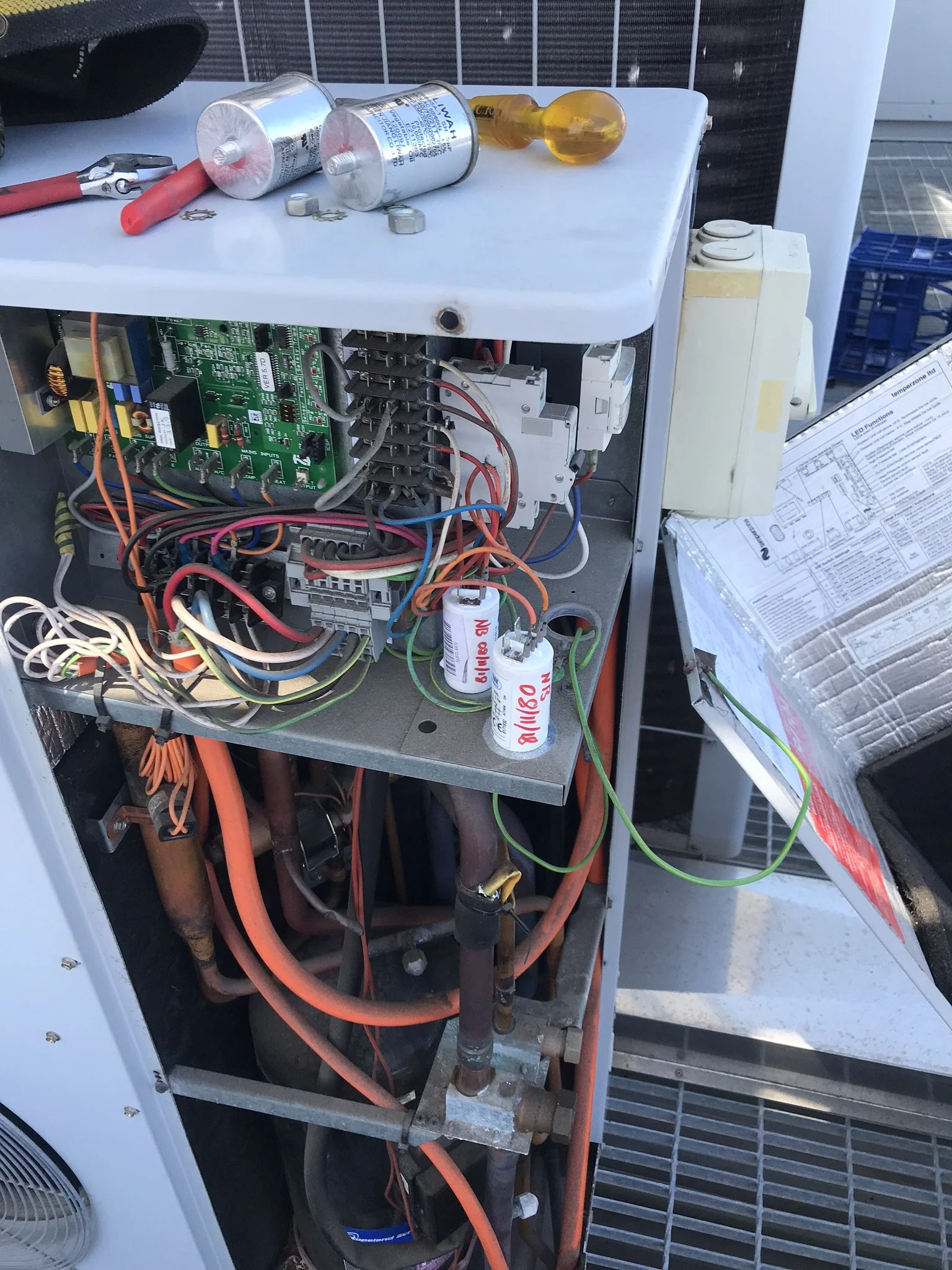
Electrical testing of the capacitor, contactor, isolator and connections
Refrigerant pressures and superheat checked against expected operating conditions, with a visual leak inspection of pipework and insulation
Condensate drain checked and flow tested
Controller and fault code history read where the system logs it
Airflow assessed at the indoor unit, and at the outlets on a ducted system
The fault explained in plain English, and a fixed price quoted before any repair proceeds
All work complies with the Refrigerant Handling Code of Practice 2025, AS/NZS 5149 and the Ozone Protection and Synthetic Greenhouse Gas Management Act 1989.
Common Air Con Faults We Repair
Not cooling or heating.
The system runs, air comes out, but the room temperature does not change. Usually a refrigerant leak, a failed compressor or reversing valve, or a system that has iced up because airflow is restricted. The cause matters, because topping up refrigerant without finding the leak is a repair that fails twice.
Water leaking from the indoor unit.
Nearly always a blocked condensate drain, a full or cracked drain tray, or a drain line that has lost its fall. On a wall-mounted split it can also be ice melting off a coil that froze because the filters are blocked. If water is reaching a ceiling, switch the system off at the isolator before you call.
Warm air from the vents in cooling.
Points at refrigerant charge, a reversing valve stuck in heating, or a compressor running but not pumping. On a ducted system it can also be a flexible duct disconnected in the roof space, so the cool air never reaches the room it was meant for.
Outdoor fan not spinning.
Usually a failed fan capacitor, a seized fan motor bearing, or an outdoor board that is not calling for the fan. Running a system with a stationary outdoor fan drives head pressure up quickly and can take the compressor with it, so switch it off until it is looked at.
Noisy operation.
A buzz at start-up with no start usually means a capacitor or contactor. Grinding or whirring from indoors is generally the fan barrel or its bearings. A rattle outdoors is often loose panels or a damaged fan blade. Noise that changes with fan speed and noise that does not are two different problems.
Musty or mouldy smells.
Mould and bacteria growing on the indoor coil and fan barrel, behind the filters where cleaning them cannot reach. This is a cleaning job rather than a repair, but the drainage or airflow fault that let it start usually needs fixing at the same time.
Fault codes and flashing lights.
The code tells you which part of the system has stopped, not which component has failed. The same code can come from a sensor, a wiring fault or the board itself, so the code narrows the search and the testing finds the fault.
Poor airflow and crushed ducting.
On ducted systems, weak airflow at the far outlets usually traces to a flexible duct crushed, kinked or disconnected in the roof, a blocked return air filter, or a collapsed duct at a tight bend. Zones fighting each other will do it too.
Zone control faults.
One room never reaches temperature while another overshoots. Usually a failed zone motor or damper actuator, a zone controller fault, or barometric relief that is not working. On ducted systems past about fifteen years, zone motors are one of the most common failures we see.
Tripping the circuit breaker or RCD.
This is an electrical fault rather than a refrigeration one, and it is the one to stop resetting. Common causes are a compressor or fan motor breaking down to earth, water in an outdoor isolator or terminal box, or damaged interconnecting cable. The breaker is protecting something.
Nothing happens at all.
Check the isolator, the switchboard and the remote batteries first. If power is present and the unit is dead, it is usually the indoor board, the transformer or a failed fuse on the board.
Tip: take a photo of any error code or flashing light pattern before you call. It speeds up diagnosis and sometimes tells us which part to bring.
Fault Codes and Flashing Lights

A fault code is the system telling you it has stopped and roughly where the problem sits. Daikin U0, Mitsubishi E6, Fujitsu E:EE, Samsung E320 and their equivalents each point at a system area, a sensor, the outdoor unit, a communication fault or the compressor circuit, but none of them names the failed component.
Artarmon Air Conditioning reads the code, then tests the circuit it points at. That is the difference between replacing a board because the code mentioned the outdoor unit, and finding the sensor that was actually open circuit.
If your system is showing a code, photograph it (if you can) and call. On a wall controller the code is usually retrieved through the controller menu, and on a wireless remote through an inspection sequence that varies by brand.
Our No-Surprise Repair Process

1. Diagnostics. Electrical testing, refrigerant checks, airflow assessment, controller scan and drain inspection.
2. Plain-English findings. What failed, why it failed, and what happens if it is left. If the cause was an installation fault rather than a worn part, you get told that too.
3. Upfront pricing. A fixed price for the repair before any work proceeds. No open-ended hourly bill.
4. Quality repair. Completed to Australian Standards using genuine or equivalent quality components.
5. Performance testing. Reassembled, cleaned where required, and run tested to confirm the fault is actually gone.
What an Air Con Repair Costs
Breakdown call, $299 including GST. This covers attendance anywhere in our service area and the initial diagnosis of the fault. It is a flat fee, not an hourly rate, and nothing is added on top for attending. You are paying for a licensed technician to work out what has actually failed, and you get that answer whether or not you go ahead with the repair.
Out-of-hours breakdown call, $499 including GST. This covers attendance outside business hours and the initial diagnosis of the fault, and any repair is quoted the same way.
The repair is quoted separately. Once the fault is known you get a fixed price to rectify it, itemised for parts and labour, and nothing proceeds until you have approved it. No open-ended hourly bill and no work you did not agree to.
Some faults need further fault finding. An intermittent fault that does not present on the day or a refrigerant leak that needs tracing all take more than an initial diagnosis. Where that is the case we will tell you on site, explain why, and quote the further fault finding before any of it happens.
If the repair is not worth doing, we say so and the initial diagnosis fee is all you have spent. See repair or replace, below.
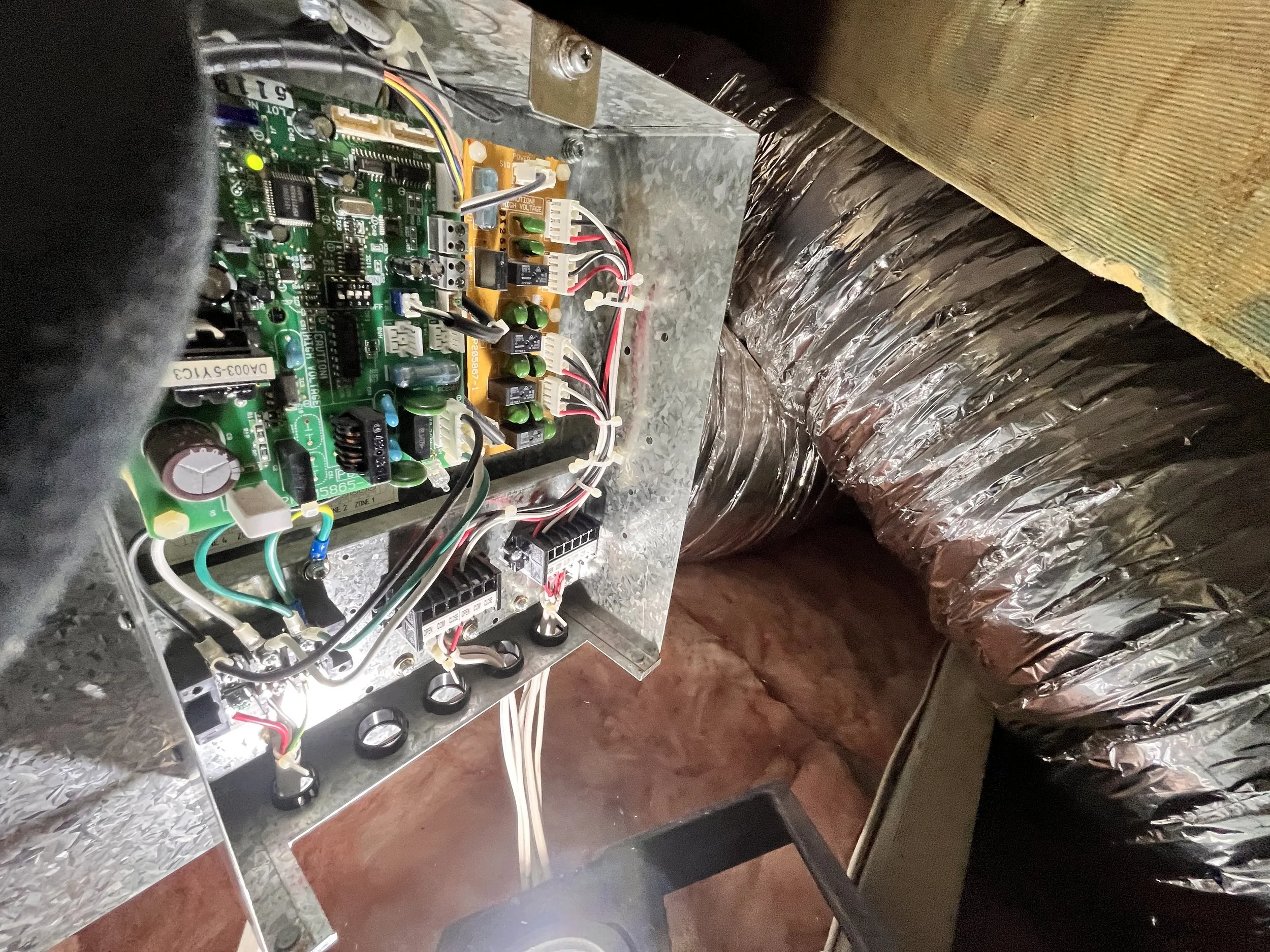
Faulty Circuit Board?
There Are Three Answers.
When an outdoor board fails, most companies quote a replacement board, and if the board has been discontinued they tell you the system is finished. That is not the whole picture, and it is worth checking before you spend thousands on a new system.
A replacement board. Still available for most systems under about eight years old. Straightforward, carries the manufacturer's warranty, and usually the right answer where the rest of the system has plenty of life in it.
A board repair. Some board faults can be repaired at component level rather than replacing the whole board. Artarmon Air Conditioning repairs the Samsung E320 outdoor board fault in house. On other systems, particularly where the board has been discontinued, we can send the board to a specialist board repairer, which is often the only route left once the manufacturer stops supplying the part. A board that goes away for repair means your system is down while it does, so the turnaround matters as much as the price.
A new system. Frequently the honest answer on a smaller split system. A board failure rarely arrives on its own. The board is a large share of what the machine is worth, whatever damaged it is often still there, and once you add the fan motor, the capacitor or the leak found along the way, you have spent most of a new system keeping an old one going.
You get all three costed, with the reasoning, before you commit to any of them.
Repair or Replace: Honest Advice
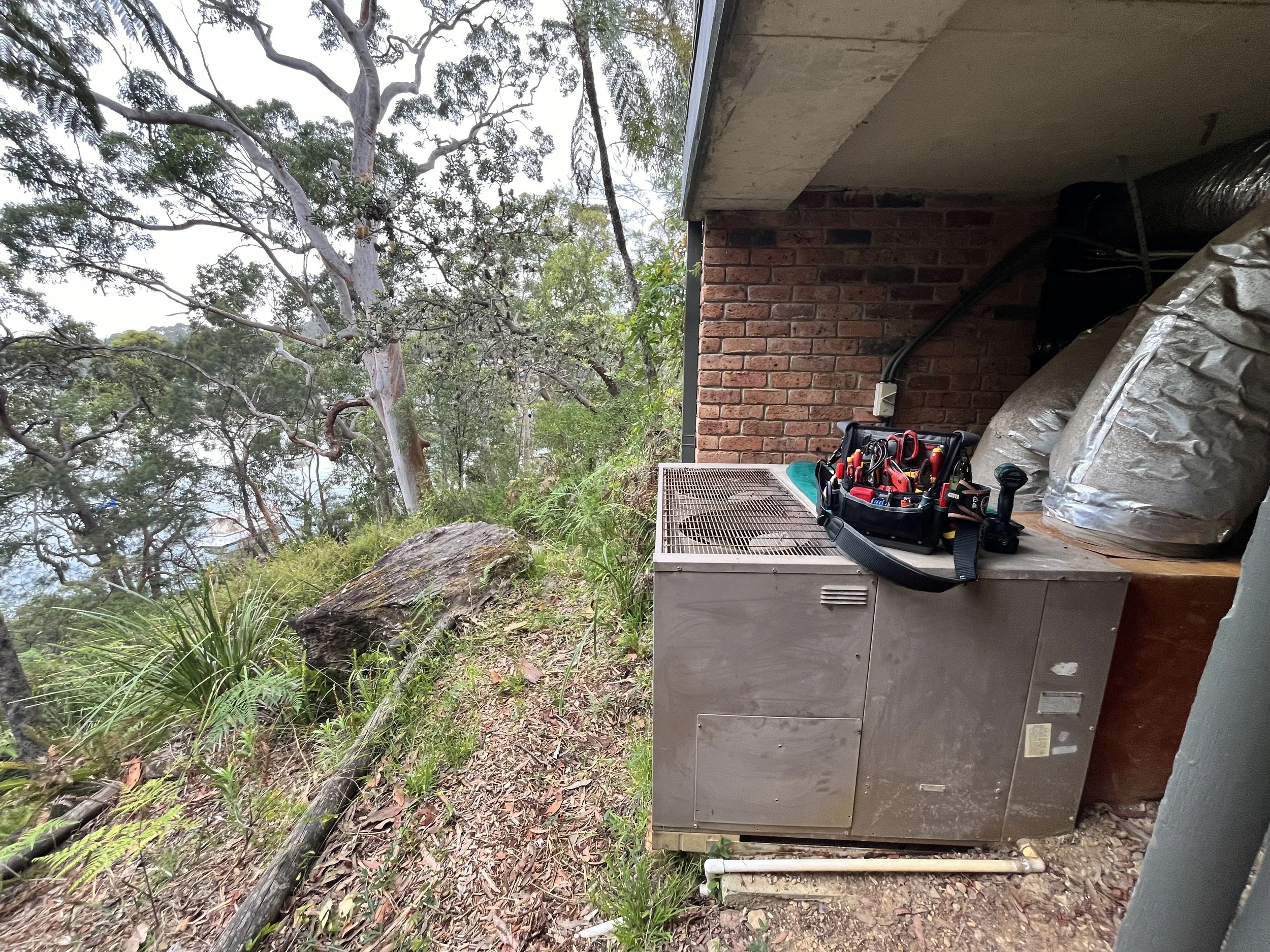
Not every air conditioner is worth repairing, and you should know that before you spend the money rather than after.
Repair usually wins when the system is under about ten years old, the fault is a single component, parts are still available, and the installation itself is sound.
Replacement usually wins when the system is past twelve years, when it runs on R22, when several major components have failed or are close to it, or when an installation fault keeps causing the same breakdown no matter what gets replaced.
On R22 specifically. R22 (Chlorodifluoromethane) has been phased out of new equipment in Australia for years due to its ozone depletion potential, supply for servicing is limited and expensive, and a refrigerant leak on an R22 system is usually the point where repair stops making financial sense. It is not illegal and your system is not unserviceable, but supply is limited and it is increasingly expensive.
The rule of thumb we use. If the repair comes to more than about 40 to 60 per cent of what a replacement would cost, and the system is past ten years, replacement is generally the better spend. Under that, repair.
We do not sell you a new system to avoid doing a repair, and we do not do a repair we know will not hold. You get the assessment, in writing, and the choice is yours.
Parts, Warranty and Guarantee
Why a repair often takes two visits. We carry generic parts that cover the common failures, capacitors, contactors, drain components and some sensors, and where one of those is the fault it is fixed on the spot. Most parts on a modern system are not generic. They are proprietary to the manufacturer and specific to the model, and one brand can list thousands of part numbers across its range. Nobody carries that on a van. So once the fault is known, the part is ordered.
Ordered parts typically take two to five business days, depending on supplier stock, and occasionally up to two weeks. As soon as the part is in, you get a priority booking rather than going back to the end of the queue. You are told the expected wait and the fixed price before anything is ordered.
Parts carry the manufacturer's warranty, which is usually 3 to 12 months. That is their number rather than ours, and it is worth knowing before spending money on a part for an older system.
Our workmanship is guaranteed for five years from completion. That covers our work: fitting the part, the connections, the brazing, the commissioning. It does not extend the manufacturer's warranty on the part itself, it does not cover a different component failing later, and it does not cover a system that has been left unmaintained. A neglected system is the one exclusion worth naming plainly, because a blocked coil and a full drain tray will eventually damage something no matter how well the last repair was done.
Board repairs we carry out ourselves carry a 12 month warranty.
Having an independent licensed technician repair your system does not affect your manufacturer's parts warranty, provided they are working under a Refrigerant Trading Authorisation. Ours is AU60391 and our NSW contractor licence is 394793C.
Service Areas
Based in Artarmon, we provide fast callouts to:
Artarmon, Chatswood, Castle Cove, Lane Cove, Willoughby, Northbridge, Naremburn, Crows Nest, St Leonards, North Sydney, Mosman, Cremorne, Roseville, Lindfield, Killara, Gordon, Pymble, St Ives, Turramurra and Wahroonga.
See every suburb we cover on our Lower North Shore and Upper North Shore pages.
Being truly local means shorter travel times and quicker response during busy summer periods.
Frequently Asked Questions
-
Artarmon Air Conditioning charges $299 including GST. This covers attendance anywhere in our service area and the initial diagnosis of the fault. It is a flat fee, not an hourly rate, and nothing is added on top for attending. You are paying for a licensed technician to work out what has actually failed, and you get that answer whether or not you go ahead with the repair.
-
Artarmon Air Conditioning will tell you on site, explain what is most likely going on, and quote the further fault finding before doing any of it. Some faults do not present on demand, and an intermittent fault, a refrigerant leak that needs tracing, or zone dampers that have to be located in a roof space take more than an initial diagnosis. You are never charged for work you did not agree to.
-
Artarmon Air Conditioning attends most Lower North Shore breakdowns the same day or the next business day, working Monday to Friday between 8am and 5pm. In peak periods it can stretch to three or four days. Existing maintenance clients are booked ahead of general callouts. Outside those hours we take out-of-hours breakdown calls for $499 including GST.
-
Sometimes. Artarmon Air Conditioning carries generic parts such as capacitors, contactors and drain components, and where one of those is the fault it is fixed on the spot. Most parts on a modern system are proprietary to the manufacturer and specific to the model, so they have to be ordered, typically 2 to 5 business days. As soon as the part arrives you get a priority booking rather than going back to the queue.
-
An air conditioner is usually worth repairing if it is under ten years old, the fault is a single component and parts are still available. Artarmon Air Conditioning recommends replacement where a system is past twelve years, runs on R22, has several failed components, or has an installation fault that keeps causing the same breakdown. You get that assessment before you spend anything on the repair.
-
A fault code tells you which part of the system has stopped, not which component has failed. Artarmon Air Conditioning reads the code, then tests the circuit it points at, because the same code can come from a sensor, a wiring fault or the board itself. Photograph the code or the flashing light pattern before you call, it speeds up diagnosis.
-
Samsung E320 means the outdoor board has read the OLP sensor, a thermistor mounted on the compressor, as open or short circuit, and the system has stopped to protect itself, but the fault is usually with one of the circuit boards. It is one of the few board faults Artarmon Air Conditioning repairs in house at component level, so an E320 usually does not mean waiting weeks for a Samsung board.
-
Daikin U4 is a transmission error between the indoor and outdoor units, meaning the two have stopped talking. It is often a glitch in one of the boards rather than a failure, so try a power cycle first: off at the isolator or circuit breaker for five minutes, then back on. If U4 returns it is a real fault, usually the interconnecting cable, a loose terminal or water in the outdoor terminal block. Artarmon Air Conditioning tests the wiring before condemning either board.
-
Sometimes. Artarmon Air Conditioning repairs the Samsung E320 outdoor board fault in house, and on other systems a discontinued board can often be sent to a specialist board repairer, which is the only route left once the manufacturer stops supplying the part. On smaller split systems replacing the whole unit is frequently the better spend, because a board failure rarely arrives on its own. You get all three options costed before you decide.
-
No. Having an independent licensed technician repair your air conditioner does not affect the manufacturer's parts warranty, provided the technician is working under a Refrigerant Trading Authorisation. Artarmon Air Conditioning holds Refrigerant Trading Authorisation AU60391 and NSW contractor licence 394793C, and is fully insured. Parts we supply carry the manufacturer's warranty, and our workmanship is guaranteed for five years.
-
Turn it off at the isolator and book a repair with Artarmon Air Conditioning, particularly if water is reaching a ceiling, a wall or electrical fittings. A leaking indoor unit is almost always a blocked condensate drain, a full drain tray or a drain line that has lost its fall, and running the system keeps pushing water into the building. We clear and flow test the drain, then fix what caused the blockage.
-
Yes. Artarmon Air Conditioning guarantees its workmanship for five years, covering our work rather than the parts, and provided the system has been maintained rather than left to neglect. Spare parts carry the manufacturer's own warranty, which is typically 3 to 12 months. Board repairs we carry out ourselves carry 12 months. All work is done under NSW contractor licence 394793C and Refrigerant Trading Authorisation AU60391.